Revolutionary characters: what made the founders different by Gordon S. Wood
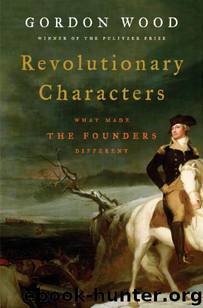
Author:Gordon S. Wood [Gordon, Wood,]
Language: eng
Format: epub
Tags: Autobiography, History: American, Political, 1775-1783; Revolution, United States - History - Revolution; 1775-1783, Political Doctrines, United States - Revolutionary War, United States - Politics and government - 1775-1783, Revolutionary, Historical - General, United States - 18th Century, United States, Historical, Historical - U.S., History, Revolutionaries - United States, Revolutionaries, États-Unis, General, U.S. History - Revolution And Confederation (1775-1789), Revolutionary Period (1775-1800), Biography & Autobiography, Statesmen, Biography, Statesmen - United States
Publisher: Penguin Group
Published: 2006-05-23T04:00:00+00:00
57805-01 2/23/06 11:08 AM Page 168
168
re vol u t i on a r y c h a rac t e r s
Suddenly in 1776, with the United States isolated and outside the European mercantile empires, Americans had both an opportunity and a need to put into practice these liberal ideas about international relations and the free exchange of goods. Commercial interest and revolutionary idealism thus blended to form the basis for American thinking about foreign affairs that lasted well into the twentieth century. To some extent this blending is still present in our thinking about the world.
Trade would be enough to hold states together and maintain peace in the world. Indeed, for Madison, Jefferson, and other idealistic liberals like Thomas Paine, peaceful trade among the people of the various nations became the counterpart in the international sphere to the sociability of people in the domestic sphere. Just as enlightened thinkers foresaw republican society held together solely by the natural affection of people, so too did they envision a world held together by the natural interests of nations in commerce. In both the national and international spheres monarchy and its intrusive institutions and monopolistic ways were what prevented a natural and harmonious flow of people’s feelings and interests.
These enlightened assumptions lay behind the various measures of commercial coercion attempted by Madison, Jefferson, and other Republicans throughout the 1790s and the early decades of the nineteenth century. The Republicans knew only too well that if republics like the United States were to avoid the consolidating processes of the swollen monarchical powers—heavy taxes, large permanent debts, and standing armies—they would have to develop peaceful alternatives to the waging of war. Madison was not a complete utopian. He feared, as he wrote in 1792, that “a universal and perpetual peace . . . will never exist but in the imaginations of visionary philosophers, or in the breasts of benevolent enthusiasts.” Nevertheless, because war was foolish as well as wicked, he still hoped that the progress of reason might eventually end war, “and if anything is to be hoped,” he said, “every thing ought to be tried.”48
The ideal, of course, was to have the world become republican—that is, composed of states whose governments were identical with the will of the people. Jefferson and Madison believed that unlike monarchies whose 57805-01 2/23/06 11:08 AM Page 169
i s t h e re a “ ja m e s m a d i s on p r ob l e m” ?
169
wills were independent of the wills of their subjects, self-governing republics were likely to be peace-loving, a view that Hamilton had only contempt for. Madison did concede that even republics might occasionally have to go to war. But if wars were declared solely by the authority of the people and, more important, if the costs of these wars were borne directly and solely by the generation that declared them, then, wrote Madison,
“ample reward would accrue to the state.” All “wars of folly” would be avoided, only brief “wars of necessity and defence” would remain, and even these might disappear.
Download
This site does not store any files on its server. We only index and link to content provided by other sites. Please contact the content providers to delete copyright contents if any and email us, we'll remove relevant links or contents immediately.
| Africa | Americas |
| Arctic & Antarctica | Asia |
| Australia & Oceania | Europe |
| Middle East | Russia |
| United States | World |
| Ancient Civilizations | Military |
| Historical Study & Educational Resources |
Cat's cradle by Kurt Vonnegut(15441)
Pimp by Iceberg Slim(14662)
4 3 2 1: A Novel by Paul Auster(12505)
Underground: A Human History of the Worlds Beneath Our Feet by Will Hunt(12144)
The Radium Girls by Kate Moore(12089)
Wiseguy by Nicholas Pileggi(5841)
The Fire Next Time by James Baldwin(5501)
Perfect Rhythm by Jae(5460)
American History Stories, Volume III (Yesterday's Classics) by Pratt Mara L(5337)
Paper Towns by Green John(5247)
Pale Blue Dot by Carl Sagan(5076)
A Higher Loyalty: Truth, Lies, and Leadership by James Comey(5017)
The Mayflower and the Pilgrims' New World by Nathaniel Philbrick(4540)
The Doomsday Machine by Daniel Ellsberg(4538)
Killers of the Flower Moon: The Osage Murders and the Birth of the FBI by David Grann(4488)
The Sympathizer by Viet Thanh Nguyen(4440)
Too Much and Not the Mood by Durga Chew-Bose(4386)
The Borden Murders by Sarah Miller(4375)
Sticky Fingers by Joe Hagan(4253)
